by Merissa Pimenta | Dec 6, 2019 | Uncategorized
Someone you love has been murdered, or was killed by a drunk driver. It is an understatement to say that your life has been changed. Your anger and pain are deep, and it will take a great deal of hard work and time to recover. You may never feel as if you have “recovered.” It may be difficult to believe now, but many persons who have been in your situation learn to manage their grief. You will need time, determination, and the support of a caring listener. The feelings you experience are likely to be very difficult and foreign for you, but most likely, they will be similar to what others have felt. This guide was written to help you, as the survivor of a homicide victim, cope with the fears and anxiety of losing someone close to you.
How to cope with the Holidays?
Holidays can be an extremely difficult time for you. They are usually an accumulation of traditions or customs created by families to be shared with family members. When a member of the family is no longer there to share a cherished tradition, the holiday can become a painful reminder instead of a time of joy. The first time you celebrate a holiday after a death, it may become a nightmare. Holiday gifts that once were ripped open immediately may sit for days. Thanksgiving is hollow. “What do I have to be thankful for?” is a common reaction for the survivor. New Year’s Day and birthdays, which celebrate another year of life, become reminders of death. You may find the need to develop new traditions. For some, a trip out of town at holiday time may be beneficial. A birthday can be observed by donating to a charitable organization or doing something that is meaningful to you. Sometimes being with other family members and talking together about the good times experienced in the past can be a source of strength. There is no rule to follow on how to “get through” a holiday. You will grieve. Allow yourself to grieve. It’s all part of the healing process.
What are some examples of self-care?
- Positive Affirmations – Each day (or in stressful situations) think through some kind thoughts about yourself and your life. Remind yourself that you have taken steps to care for yourself that might seem easy but are very important, like taking a shower, getting out of bed, or going for a walk.
- Relaxation Exercises – Anything from breathing techniques to practicing meditation and creating bedtime routine can help to create a relaxing environment to heal and reflect.
- Channeling pain into creativity – Taking up activities like poetry writing, short stories, journaling, drawing or dance serve as outlets to release and process emotions that might otherwise be overwhelming.
- Physical Self-Care – Getting up and moving your body in a way that feels good to you can change your whole mood. If you’re not a person who loves the gym, you can go for a walk with a friend, do some stretches, or dance at home to some feel good music.
- Know and communicate your boundaries – Let others around you know up front what is and is not okay for you.
- Ask for help – No one should be expected to go through life alone and everyone needs help from time-to-time. Asking loved ones for help with life feels overwhelming is important.
- Remind yourself it is okay to walk away from situations that are too stressful or triggering.
A guide to survival for family and friends of homicide victims. Office of Victim Services, Montana Department of Justice, p.3. https://dojmt.gov/wp-content/uploads/2011/05/guidesurvival.pdf
by Victims For Justice | Apr 1, 2019 | Uncategorized
Media coverage of crime greatly influences public perceptions about victims. As reporters rush to meet deadlines, particularly in the immediate aftermath of crimes, their reporting may not reflect the desired sensitivity to traumatized victims. Because many reporters do not receive training about how to interact with victims, you have an opportunity to help them approach crime stories with sensitivity. As a victim advocate who understands the perspective of victims and knows what reporters need to include in their stories, you play a key role in advocating for victim-sensitive coverage of crime.
Advocating for victims with the media also includes helping victims decide whether to accept interviews, how to minimize invasions of their privacy, and how to exercise their rights and options in dealing with reporters. Advocates can also help victims anticipate questions and prepare how to answer them. Before the Interview
By giving victims the following checklist of questions and walking through it with them, you can help victims decide whether to participate in an interview:
- What are your goals in speaking to the media? What purpose do you hope the interview will serve? Will it help the community learn more about your loved one or understand the impact of crime on victims? Are you willing to answer questions from reporters who might not understand your pain or your point of view?
- Would the interview invade your privacy? If you are still struggling with the emotional, physical, or financial impact of the crime, would speaking to a reporter disturb you or violate your privacy? You may want to discuss the pros and cons with a victim advocate before making your decision.
- Does refusing the interview increase or decrease your control over what is published about the crime? Denying an interview will not prevent publicity about your case. If the story is newsworthy, the media will publish the story with or without interviewing you. Also, an interview may provide you with an opportunity to offer your perspective on the crime.
- Would you prefer that someone else speak for you? If you would rather not be interviewed, you may ask someone else — an attorney, a victim advocate, a clergy member, a family member, or a friend — to represent you in media interviews. That person can also release written statements on your behalf or accompany you to interviews if you decide to accept them.
- Would granting an interview affect the investigation or prosecution of the crime? Giving an interview may compromise the investigation or prosecution of a crime. You may want to speak with an advocate or an attorney before deciding to grant an interview.
- Do you want to set conditions for the interview? Although reporters and producers may not agree to the conditions you suggest, they will most likely comply with reasonable requests if they want your interview. You have the right to ask or express your wishes regarding:
- Time and location of the interview
- Visiting the set or location before an interview
- Advance information about questions, the reporter’s angle, or plans for using your interview
- Requesting that a victim advocate, lawyer, or support person be present
- Issues you will not discuss » Requesting a specific reporter or producer
- Protecting your identity (through silhouettes and electronic distortion of your voice)
- Excluding children and other family members from the interview
- Excluding photos and other images you find offensive
- Excluding offenders or other participants to whom you might object
Preparing Victims for the Interview Share the following tips with victims who agree to interviews:
- Bring a trusted individual to provide support.
- Prepare for the interview by having an advocate list questions the reporter may ask and rehearsing responses.
- Refuse to answer a question by:
- Polite refusal: “I’m sorry, but I don’t want to talk about that.”
- Bridging: Change the subject to what YOU want to talk about. Answer by saying, “What is really important about that issue is…” and then talk about what you think the audience should know.
- Never speak “off the record.” Reporters may publish or broadcast anything you say.
- If you don’t know the answer to a question, simply say you don’t know. Don’t guess or speculate.
- You may request a correction if the article is inaccurate or you are quoted out of context. Newspapers and other outlets may publish corrections and television news may correct serious errors (although the option to do so is theirs). You can also contact management at the news outlet prior to publication or broadcast if the reporter was aggressive, insensitive, or obtained information dishonestly.
- You may refuse a follow-up interview, even if you have previously agreed to be interviewed a second time. Victim advocates can play a key role in mediating between reporters and victims, especially when victims feel vulnerable and stressed. The victim, his or her family, and the wider community have an important interest in ensuring that media coverage is sensitive, accurate, and does not put the victim under duress or at risk.
1 Bonnie Bucqueroux and Anne Seymour, A Guide for Journalists Who Report on Crime and Crime Victims, (Washington, DC: Justice Solutions, 2009), 2–10, accessed
November 20, 2018, www. mediacrimevictimguide.com/journalistguide.pdf.
by Merissa Pimenta | Apr 1, 2019 | Uncategorized
Media coverage of crime greatly influences public perceptions about victims. As reporters rush to meet deadlines, particularly in the immediate aftermath of crimes, their reporting may not reflect the desired sensitivity to traumatized victims. Because many reporters do not receive training about how to interact with victims, you have an opportunity to help them approach crime stories with sensitivity.
Tips for Reporters:
In writing news stories about crime, reporters have the difficult task of seeking interviews from victims and conducting those interviews in an ethical manner when victims agree to speak. Advocates can help reporters prepare to speak with victims by offering suggestions about how to approach victims so that they feel comfortable and safe. Educate reporters on how to approach crime victims by sharing the following guidelines.1
Asking for the Interview
- Recognize that the victim may be coping with shock and trauma.
- Approach the victim initially without equipment — notebooks, tape recorders, cameras, and lights — and try to make a human connection.
- Introduce yourself as a reporter, give the victim your name and title, and briefly explain what you hope
- Express concern for the victim by saying, “I am sorry for what happened to you” or “I am sorry for your loss.”
- Ask victims how they would prefer to be addressed, and observe that preference in all of your questions.
- Give the victim a reason to speak with you by explaining the purpose of the story, the fact that it will be published, and why the victim’s participation is important.
- Tell the victim how much time you need and observe that time limit.
- Courteously accept the victim’s refusal if he or she is unwilling to be interviewed.
- If the victim declines, express interest in a future interview, leave a business card, or send an email with your contact information, and ask for the names of others who may be willing to speak.
Logistics and Other Considerations
- Make the victim comfortable — offer a chair or suggest a comfortable, safe place to talk.
- Respect the victim’s space — because people experiencing trauma often do not want to be touched, hand the microphone to the victim and explain how to adjust it.
- Ask permission to record the interview.
- Clarify ground rules — explain that anything the victim says may be used in the interview.
Bonnie Bucqueroux and Anne Seymour, A Guide for Journalists Who Report on Crime and Crime Victims, (Washington, DC: Justice Solutions, 2009), 2–10, accessed
November 20, 2018, www. mediacrimevictimguide.com/journalistguide.pdf.
by Merissa Pimenta | Feb 7, 2019 | Uncategorized
Before we dive into the topic of the tool I want to mention that in late January, Governor Dunleavy introduced SB 33 which seeks to no longer use the risk assessment tool. Also while it would retain pretrial supervision, the Pretrial Enforcement Division (PED) would no longer exists as its own department. Instead the bill would give judges the discretion to decide pretrial terms of their own for the person charged with the crime.
Until/if this bill passes the legislature in current form, Alaska will continue to use the risk assessment tool and the PED will still be their own department. Because of this we still feel it’s important for victims to know how the tool works.
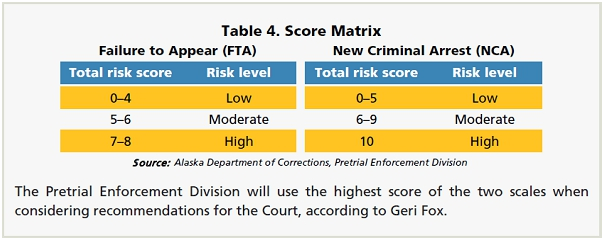
On January 1, 2018 the state of Alaska began using a new pretrial risk assessment tool that calculates whether a defendant is at low, moderate, or high risk for failure to appear in court or to commit another crime if released.
One major reason why this tool was created was to reduce the number of pretrial inmates in Alaska’s prisons, which had grown by 88% from 2004 to 2014.
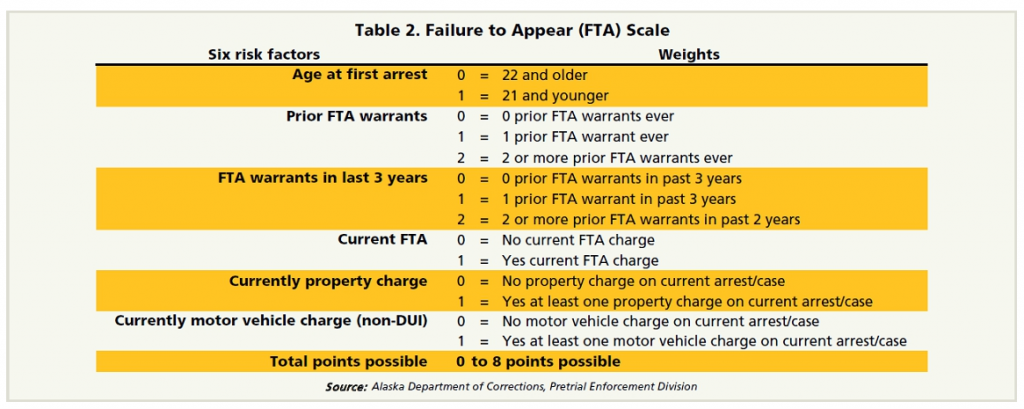
In order to know how likely an inmate would be a risk factor with Failure to Appear (FTA) the state looks at factors such as age of first arrest, prior FTA warrants, if they have a current property crime and if they currently has a motor vehicle change (non-DUI).
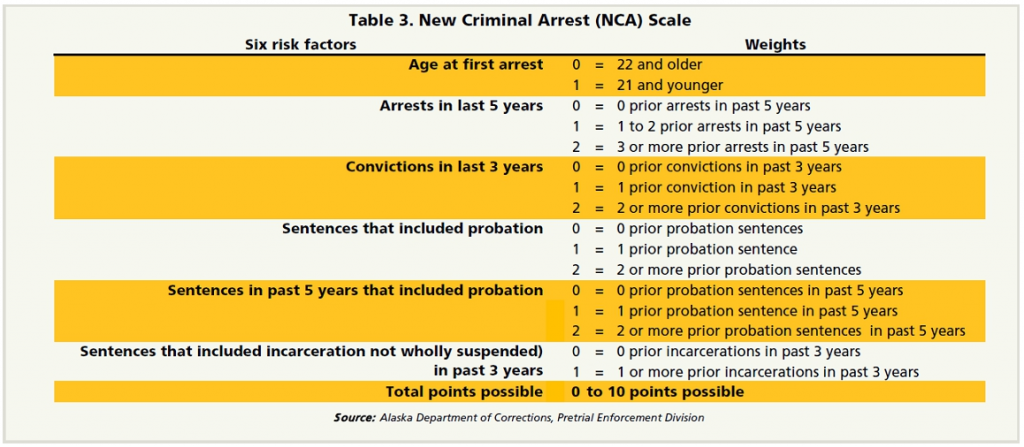
When deciding the risk of an inmate being charged with a New Criminal Arrest (NSA) while out on pretrial release the tool looks at the age of their first arrest, how many arrests they’ve had in the last five years, how many convictions in the last three years, and probation associated with these arrests.
The Pretrial Enforcement Division will use the highest score of the two scales when considering recommendations for the Court.
This information is given to the judge, prosecutors and defense attorneys prior to a bail hearing. Besides the information provided by the pretrial risk assessment tool, the judge is still going to consider statutory guidelines such as the nature and circumstances of the offense, weight of the evidence, family ties, employment, length of residence, conviction record, failure to appear record, danger the defendant poses to the victim, as well as the reputation, character, and mental condition of the offender.
A defendant’s score does not take into account factors such as the charges in a defendant’s case, the possible sentence, any potential harm to the public, weight of evidence, and a defendant’s ties to the community or their personal financial resources.
In June of 2018 HB 312 was signed into law which changed the risk assessment tool for the better, and gave judges more discretion when setting bail terms. Firstly, the law allows judges to consider the defendants out-of-state criminal history. Also, before this law was enacted, part of the risk assessment tool was a mandatory provision that required judges to release defendants charged with either low-risk class-C felonies or low-risk and moderate-risk misdemeanors. The new law allows judges to keep a person in custody for low-level offenses when looking at the available facts on the case.

Recent Comments