
Introduction into Alaska’s Department of Juvenile Justice with Lizbeth Meredith

Introduction into Alaska’s Department of Juvenile Justice with Lizbeth Meredith

Victims For Justice (VFJ) was founded on fighting for the rights of victims, specifically in the juvenile justice system. Janice Lienhart and Sharon Nahorney’s parents and aunt were brutally murdered during a home invasion by juveniles. Following the murder, a hearing was held but was closed to the public, denying all rights of the family to defend their lost loved ones. It is because of this that the sisters founded VFJ in order to secure rights for victims in the juvenile justice system.

Currently, victims are still confused as to how the juvenile system works. Victims often expect that the juvenile system works similarly to the adult criminal justice system. But it doesn’t. Lizbeth Meredith, a Supervisor at the Department of Juvenile Justice (DJJ) for twenty years, and a long-time friend of VFJ provides a thorough explanation of how DJJ works, along with the difference between the juvenile and adult justice systems and some of the frequently asked questions the department receives.

Meet Lizbeth Meredith

Based in Anchorage, Alaska, Lizbeth holds a bachelor’s degree in journalism and a graduate degree in psychology. She was motivated to get in this line of work as a result of being a victim of domestic violence herself, and the ability to work with victims while also working with offenders and having a positive impact in the community also was a huge motivator.

The Process

Every day when we get to work, there is a stack of referrals we need to sort through. We view whether, the juvenile is in detention, depending on the seriousness of the crime, or, if it was not a serious crime, we just review the police report.  We work on an appropriate response to the police report. We investigate what the juvenile’s treatment needs are and review their record to determine if this is a circumstance where the juvenile can clean up their mess and be held accountable without going to court. Probation Officers are also on call 24/7 and take the police’s phone calls to decide which juveniles are admitted into the detention center or who stays in the community.

Once we discover what drives their behavior, for example, substance abuse, bad peer group, mental health concerns, we determine whether we can assist in restoring the victim and helping the juvenile not get in trouble again and therefore, restoring the community. We do this without going to court and it is worth mentioning that it is not typical for juveniles to come back into the juvenile system. A lot of juveniles do not need treatment as they are, by nature, impulsive, and commit criminal mischief like stealing someone’s car or writing dirty words on the schoolbook.

We also analyze if the parents need support and whether they are open to getting that support. Supervising juveniles in the community and giving them the resources, they need lets us see if we are able to have a positive impact on their behavior.

There are not enough resources in the state for District Attorney’s to be involved in every case. Sometimes there are issues that need to be discussed with the District Attorney such as restitution issues or whether the case was serious enough to go to court. We have the privilege of consulting with dedicated smart attorneys, and we get their full support when we’re dealing with crimes that endanger the community.

Juvenile Probation Officers

If the case is serious, a Juvenile Probation Officer (JPO), is involved. It is important to understand that every juvenile is unique. They each have different things about them developmentally and familywise. At the Department of Juvenile Justice, we want to know what throws their behavior and know what resources are available.

Some of the JPO’s duties are:

-Filing petitions with the court.

-Making appropriate referrals for services, whether or not the case goes to court.

-Recommending a different placement for juveniles other than their homes when they are not safe or properly supervised there.

– Arrests if the juveniles are violating court orders. I must admit that we are doing less of that with COVID-19.

-Negotiate conditions of some plea offers.

FAQ’s the Department of Juvenile Justice receives:

  • When entering denials during the first arraignment: Why is the juvenile pleading not guilty, he told police officers he committed the crime.

Response from Liz: This is a procedural matter. The defendant’s lawyer often does not have all of the evidence to reasonably advise their client.

  • Length of the sentence: Why is it a juvenile is convicted of only 2 + years or up until the age of twenty for committing a homicide when adults are sentenced to up to 20 years for the same crime?

Response from Liz: If the juvenile committed a crime while he was sixteen years old or younger, he is not subject to the same conditions as an adult is.

The difference between the Juvenile and Adult Justice System

In the adult criminal justice system, they are dealing with the age groups of 16-70, are overwhelmed, and have to rely on more cookie-cutter sentencing. In the juvenile system, we work with kids between the age groups of 11-20 if the crime occurred before they were 18. We believe in rehabilitation over punishment. We are trying to hold them accountable and help juvenile offenders clean up the mess they may have caused their victims or the community with the resources we have available.

Victim impact

At DJJ, we have victim contact as we are fostering a relationship with the victim as we decided whether the victim can be restored informally or whether the case will go to court. We are aware that there are circumstances where victims have little information on the process throughout the trial or disagree with a sentence. The truth is, we have to do better. We have to keep victims informed of the plea deal and conditions in advance as does the District Attorney’s Office. If a victim does not agree with a plea deal, they have the right to let us know or contact the Office of Victims’ Rights or Victims For Justice, depending on the types of crimes.

A victim also has the right to restitution.  Sometimes we have a difficult time getting the paperwork needed from victims in order to proceed with orders. However, we understand that they have so much going on right now, in the middle of a legal process, counseling costs, providing receipts, so much that they didn’t ask to be a part of. Victims who cannot get their documentation to the division in a timely manner are sometimes encouraged to pursue restitution civilly.

Closing Remarks from Liz

Liz wishes victims to know that it is important that they get the Probation Officer’s e-mail address and that they share their e-mail addresses with the Probation Officer. “It is important victims feel comfortable communicating with the Probation Officer and that they know they have the option of calling a Probation Officer Supervisor,” Liz says.

Liz is retiring at the end of this month and is looking forward to focusing on her passion for writing, along with developing a podcast. Please join us in thanking Liz for her dedication while serving DJJ for 20 years and wishing her a farewell.
Frequently asked questions Advocates receive concerning delays in the legal system

Alaska Chief Justice Joel Bolger issued a special order suspending all in-person criminal and civil jury trials until November 2nd, 2020. The order will be in place unless it is suspended at a review on September 18th.

Undoubtedly, victims have questions. Victim service providers, such as Victims For Justice (VFJ), and the Office of Victims’ Rights (OVR), do not have all of the answers. As we navigate these changes in the justice system, we’d like to provide you with some of the frequently asked questions that victim service providers, such as VFJ, and OVR receive from victims, along with the answers provided to the best of their abilities.

1. Why are there delays in my case?

Office of Victims’ Rights Director, Taylor Winston, explains we are in a very particular situation because of COVID-19. Many defendants would like to go to trial but can’t. Countless victims are frustrated with the delays. There are an approximate of 800 unclassified class A level felony cases that are over two years old and have not gone to trial. Simultaneously, the volume of cases across the state continues to rise. There are issues in the criminal justice system that the coronavirus has only exacerbated.

Because of the health mandates in the state, the logistics of holding a trial are very complicated. People that are not involved in the criminal justice system may not be aware of all of the levels of involvement that come with a trial. For instance, take the jury selection process. Many individuals are not comfortable with risking their health while attending a jury trial. Another complication is that courtrooms across the state are different sizes, therefore, in the case of small courtrooms, even if you socially distance everyone, you cannot fit all of the necessary actors that have to be there for the trial such as the Defense Attorney, District Attorney, Defendant, Judge, jurors, witnesses, and the public. It would not be fair for some cities in Alaska to have the ability to hold trials while other cities are not equipped to do so. That is another aspect, the courtrooms are open to the public. The question of who would be required to wear masks and who wouldn’t be is also being discussed.

Taylor Winston says many discussions are being held at an inter-agency level as to how to hold trials fairly so that victims and defendants’ rights are protected. She warns, if things are not done cautiously, there can be many appeal ramifications to a case. Victims do not want their case to go to trial that would eventually end in appeal. An alternative is a bench trial which must be agreed upon by the state and defense Attorneys.

2. Is there anything I, as a victim, can do to advocate for my case?

Michelle, Victim Advocate with VFJ, explains victims have a constitutional right to a timely disposition. An Advocates’ role is to help ensure the victim’s voice is heard, whether that is through the conversation with the prosecutor or an impact statement to the judge.  Although there are delays in the system, in some instances, Advocates find it appropriate to refer victims to the Office of Victims’ Rights.

OVR’s position is that while there is a constitutional right to a timely disposition in a case, the halting of trials has resulted in the defendants’ rights also being imposed upon. There is no legal argument that OVR lawyers can make in court at this time, that will substantiate the need for victims’ rights to a timely disposition, as defendants are also facing substantial delays in their right to a speedy trial, Taylor Winston says.

What to expect.

Being upfront with people navigating the criminal justice system and mitigating their expectations as to the timely disposition of a case is very important. On a good year, Advocates estimate the duration of the legal process for a homicide case to be two and a half years. With the current backlog in the legal system, they now tell victims of homicide cases to expect a trial to occur within three and a half to four years. Advocates explain that although victims are concerned, even if the trial were to occur, this doesn’t necessarily mean they will get closure. An Advocates’ job is to listen, be another set of ears, assist in processing all the information, and provide resources to victims such as peer support and counseling.

Advocates are also feeling the impact. They miss the support-network interaction that they would get while providing in-person court accompaniment. However, they are working remotely and listening to the hearings. “It’s just not the same, we’re doing the best we can to answer the needs of our clients without in-person visits, at a distance,” Michelle Evans says.

So… when will trials start up again?

Taylor Winston explains that the startup of trials will not happen before November 2020. Discussions are happening and the legal system is brainstorming on the safest way for trials to start back up in November. A potential plan is to start with misdemeanor trials, which logistics wise, are a lot less complicated. Depending on the number of coronavirus cases in our state and how the misdemeanor trials run, more trials will be added, including felony cases.

“I consider that the Supreme Court is being thoughtful of people’s health and both the rights of defendants and victims. A common feeling amongst victims is that they are not treated fairly. This is the one place where victims and defendants are on the same level playing field, they both are being treated equally, this is what justice should be, rather than forcing cases to go to trial”, Taylor explains. We understand victims’ frustrations and want them to know that their concerns do not go unnoticed and the delays have not been decided upon lightly.

The Office Of Victims’ Rights is an agency of the Alaska Legislature that provides free legal services to victims of crime to help them obtain the rights they are guaranteed under the Alaska constitution and statutes about their contacts with police, prosecutors, judges, and other criminal justice agencies in this state, as well as to advance and protect those victim rights in court when necessary and authorized by law. For more information on OVR visit https://ovr.akleg.gov/

A pledge to “do the work”

Victims For Justice was founded on fighting for the rights of those who were not represented in the criminal justice system. The victim services field, similarly, has deep ties to the civil rights movement and ensuring safety for those who were underrepresented, even when it was in makeshift shelters and church parking lots.

While work has been done over the years to increase services for victims of violence, there is no denying that the response has been inadequate when it comes to an equitable distribution of resources and services. Here in Alaska, the acknowledgement of Missing and Murdered Indigenous Women is a blatant reminder of those we have failed to protect.

Recently, I had the privilege to graduate from a masters program in which I met and worked with a number of bright, strong and diverse individuals from all over the country. For nearly two years we struggled through difficult conversations of social justice and equity. During one of these conversations, in a moment of frustration and exhaustion a friend of mine plead for everyone in the room to stop looking to her for answers and “just do the work!”

These words still reverberate in my mind. That is why this is not another letter expressing outrage and condemnation. While these feelings are understandable, they are not enough. This is a pledge to “do the work.”

Victims For Justice will continue to examine our practices on an individual service delivery level, as well as look at our role in the larger system. Our recent partnerships with the District Attorney’s Office and the Anchorage Police Department are a product of knowing victims are not being reached and served. Not only do we need to increase access to services, we need to do so through victim-centered, culturally relevant practices.

While I cannot offer you all the steps that will be taken today, we do commit to affirming and celebrating individual identities within our organization and in the communities we work with. We will continue to build relationships with everyone in a way that empowers their voice, honors their values, and highlights their strengths. We commit to understand our role in this system.

We know that to best serve victims we need to continually examine our identities as individuals and as an organization. We see this as an ongoing process that we aim to address at all levels of our work: personal, interpersonal, organizational, and systemic.

Victim voices are critical in shaping the criminal justice system. But those voices are only as effective as those they represent. If all victim voices are not heard in our community, we are not meeting the true needs of all victims.

We pledge to do that work. We will move forward with compassion, empathy and respect for all Alaskans and all victims of violence.

Victoria Shanklin
Executive Director

VFJ’s Live Q&A: Victims’ Rights and Support in the Legal System

We held our first ever Live Q&A on Thursday, June 4th. The Q&A was jointly led by Patrick McKay, Pro-Tem Superior Court Judge, Michelle Evans, Lead Victim Advocate at VFJ and Angela Pointer, the Mother of a homicide victim and Mental Health Specialist at Providence Hospital.

The Q&A covered areas such as Victims’ Rights in Alaska, Advocacy and what that looks like in the criminal justice system. The Q&A was held at a time of uncertainty, where we thought it would be appropriate to discuss questions in regard to the legal process and to provide an insight on a victims’ perspective.

Some of the key issues addressed were:

• A victims’ rights to confer with prosecution on bail and change of plea agreements.
• A victims’ right to be heard in court and in front of the parole board.
• The role of an Advocate as a liaison for victims within the Anchorage Police Department and District Attorney’s Office.
• The role of a Judges as fact-finders and their obligation to remain neutral.
• The role of a prosecutor to charge defendants as established by the legislature and prove intent beyond a reasonable doubt.
• Financial Assistance: What is the Violent Crimes Compensation Board? How do victims access this resource?
• What is the formula used to calculate good time credits at the Department of Corrections?
• Resources available such as Violent Crimes Compensation Board (VCCB), Victim Information Notification Everyday (VINE), Office of Victims’ Rights (OVR) and Victims For Justice (VFJ).

We hope that this conversation helps Alaskans better understand the rights victims are entitled to and their needs. We hope you enjoyed our event and are open to suggestions. If you missed our Q&A, you may watch it here.

Please submit your questions or comments to mpimenta@victimsforjustice.org

Thank you.

Merissa Pimenta
Development & Communications Specialist

Victim Advocacy during COVID-19

The coronavirus pandemic is reshaping how Alaskan victim service providers provide advocacy services at many levels. The Alaska Supreme Court and lower courts have issued a rapid-fire series of orders canceling hearings, postponing trials, and even temporarily altering the state’s rule that guarantees defendants a speedy trial.

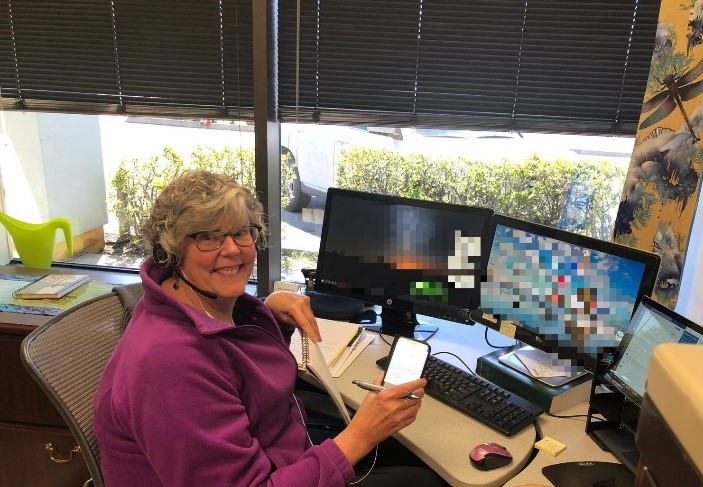
Michelle Evans, Lead Advocate at VFJ explains some of the ways VFJ adapted to the current pandemic. VFJ is still offering services such as court accompaniment. How does that look? Michelle uses two phones, one for calling the courtroom and listening into the hearing, and another to talk to the victim throughout the hearing as is seen below. Michelle says that it has certainly been challenging providing court accompaniment over the phone, “there are no visual cues, defense attorneys haven’t been next to defendant nor advocates next to the victims.”

Other accommodations have been made in order to ensure continuity of services while practicing physical distancing. VFJ purchased DocuSign in order to receive releases of information from clients throughout the state without the need for in-person visits. And, the phone system was upgraded to be accessible to staff whether they are working remotely or in the office. This ensures the availability of services to clients calling our main line.

The transition to our “new normal” was not easy. Amid the pandemic, VFJ has taken precautions necessary to ensure all client information remains safe and secure in systems updates, while not disrupting daily operations. Things are certainly looking differently. However, VFJ staff remain positive and available to provide services to victims throughout Alaska while guaranteeing confidentiality, support, and referral services.