by Paula Dobbyn | Nov 17, 2021 | Blog, News
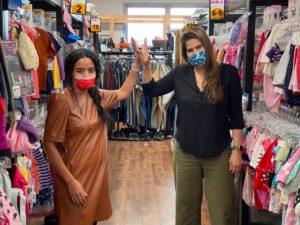
Tory Shanklin and Brittani Clancy at FashionPact store.
Brittani Clancey was a stay-at-home Anchorage mom with a taste for fashion. When the youngest of her four children went off to kindergarten, Clancey had a little more time on her hands to pursue a dream. The Anchorage-born-and-raised fashionista decided to start a business, one that would give back to her community.
She opened a thrift shop on the eastern end of downtown, with a business model that’s designed to boost revenue for local charities, Victims for Justice among them.
Her shop, located at 575 Ingra Street, is called FashionPact. It sells a wide variety of gently used clothes, accessories, household items and more. Clancey calls it a “resale boutique.”
Boutique or not, what sets FashionPact apart from other thrift shops is that a large share of everything Clancey earns she donates to over 50 local nonprofits serving Anchorage. The nonprofits are all homegrown, she said.
“Being from Anchorage, local is really important to me,” Clancey said.
Everything in the store sells for five dollars. Whoever donated the item gets to choose a nonprofit they want a dollar of the proceeds to go to and the buyer gets to do the same. With this formula, Clancey keeps three dollars and the other two go to charity.
“The charities basically don’t have to do anything. They sign up with us and they continue receiving a check each month,” she said.
Clancey uses custom software to track everything in the store via QR code. Once an item is purchased, the software directs the funds to be disbursed once a month to the appropriate nonprofit.
“I don’t think this model would be possible without it,” Clancey said.
Clancey counts on community members to donate items. Things are going well since she opened in June but she anticipates that things will slow down after the holidays. She urges anyone with gently used, fashionable clothes to donate them and shop, especially in January and February.
“We need a lot of volume. We need people coming in to shop and we need people coming in to donate. We have to sell a couple hundred items every day to stay in business.”
Victims for Justice executive director Victoria Shanklin recently stopped by FashionPact to thank Clancey for what she is doing for the community.
“Our organization has already benefitted greatly from FashionPact. In fact, it puts larger programs like AmazonSmile to shame! This is a perfect example of how for-profit can merge with non-profit to really make a difference in our community. This is transformative for Anchorage and we can’t thank Brittney enough. Visit! Donate! Shop!,” Shanklin said.
To see a list of the nonprofits that FashionPact supports, visit the shop’s website.
by Paula Dobbyn | Oct 12, 2021 | Blog, News
A new statewide survey reveals a staggeringly high percentage of Alaska women face victimization in their homes, relationships and communities, figures that are likely underreported and on the rise.
According to the 2020 Alaska Victimization Survey, conducted by the University of Alaska Anchorage (UAA) Justice Center and the Council on Domestic Violence and Sexual Assault, nearly 60% of Alaska women surveyed reported having experienced intimate partner violence, sexual violence, or both during their lifetime.
That’s a 14.7% increase from a similar study conducted in 2015.
Some 2,100 women over 18 participated in the survey. It found that 48 out of 100 Alaska women reported intimate partner violence; 41 out of 100 Alaska women experienced sexual violence; and 58 out of 100 experienced either of these types of violence over the course of their lifetime.
“This survey helps give voice to the hundreds of victims of violence across our diverse state,” said L. Diane Casto, executive director of the Alaska Council on Domestic Violence and Sexual Assault.
The data shines a light on the scope of the problem, increases public awareness and should help policymakers better align and direct resources to the areas that need them the most, she said.
The lead researcher on the project was UAA’s Dr. Ingrid Johnson.
The numbers were collected via household survey of randomly selected adult women in Alaska. Participants are asked a series of behaviorally specific questions to determine their experiences with lifetime and past year intimate partner violence, sexual violence, and stalking, according to the researchers.
The high abuse statistics likely reflect only a fraction of what Alaska women actually experience.
Numerous studies, including national victimization surveys, have found the majority of individuals who experience rape/sexual assault and nearly half of those who experience intimate partner violence do not report their victimization to police.
Researchers say the best way to gather data on crime victimization is to ask a large number of individuals whether or not they have been victimized, and make estimates based on those data.
Read the study here.
by Paula Dobbyn | Oct 12, 2021 | Blog, News
As the victim of a violent crime, you may be wondering when the person who harmed you will appear in court for the first time.
If the charge is for a misdemeanor crime, the defendant will have an arraignment. An arraignment is usually the first court proceeding in a criminal case. It’s when a judge tells a defendant what he or she is charged with and what their rights are in the court process. The judge asks whether they want to plead guilty, not guilty or no contest.
If the defendant is in jail, the arraignment should happen within 24 hours of the arrest. If the prosecutor does not file a charging document by the time of arraignment, the judge releases the defendant from jail. The prosecutor can still file charges later. If the defendant was not in jail, the arraignment may be scheduled within a few weeks.
If the person is charged with a felony crime, they appear before the court within 24 hours after arrest. This hearing is called a first appearance, and initial appearance or a Rule 5 hearing. At this time, a judge reads the charges and advises the defendant of his or her rights. There will be an arraignment at a later date.
In essence, Rule 5 is a criminal procedure rule that provides required timelines for when people who have been arrested or cited must appear in court for an arraignment or felony first appearance.
by Paula Dobbyn | Oct 8, 2021 | Blog
Although Alaska leads the nation in the number of violent crimes per capita, authorities reported a steep drop in crime in Alaska in 2020.
According to the Crime in Alaska 2020 report released by the Alaska Department of Public Safety in September 2021, Alaska’s overall crime rate fell by 18.5% last year as the coronavirus pandemic continued to grip the nation. The total number of reported violent crimes decreased by 3.7% and the number of property crimes decreased by 22.9%, the lowest total number of reported property offenses since 1974.
Alaska reported 48 homicides in 2020, a decrease of 31.4% from the prior year. The murder rate per 100,000 persons decreased 31.4% between 2019 and 2020.
Nationally, the murder rate increased by nearly 30% from the prior year, an unprecedented spike. According to the FBI, there were 9,630 homicides in the United States, the largest single-year increase in the murder rate since the agency began tracking these crimes in the 1960s.
One category of violent crime that did not decrease in Alaska in 2020: rape. The rate went from 151.2 to 154.8 per 100,000 people, according to the FBI.
The actual figure is likely higher since many victims of rape and sexual assault never contact law enforcement, a situation exacerbated by Covid lockdowns. Domestic violence (DV) and sexual assault (SA) agencies have reported an increase in services and calls since the pandemic began. With the public largely isolated from third-party mandated reporters, such as school teachers and nurses, advocates estimate that DV and SA numbers are much higher than official numbers.
Alaska’s violent crime rate of 838 incidents for every 100,000 people makes Alaska the most violent state in the nation. The vast majority of violent crimes reported in Alaska in 2020 — 69% — were aggravated assault.
by Paula Dobbyn | Sep 16, 2021 | Uncategorized
Victims for Justice is thrilled to announce it has hired Tamara Maddox as its newest victim advocate. Maddox comes to VFJ from Denali Law Group where she was an associate attorney. Tamara will primarily work from the Anchorage District Attorney’s offices in downtown Anchorage. Tamara is filling a position that was created in partnership with the D.A.’s office to better serve Alaskans who have been affected by crime and are navigating their way through the criminal justice system.
Tamara took time to answer some questions about herself so that you can get to know her. What follows are interview excerpts.
Q: Tell us about yourself.
A: I grew up on the southside of Anchorage. I’ve always considered myself an ambitious problem solver, eager to solve the world’s greatest dilemmas. I always knew I wanted to pursue a law degree, so in primary school, I got involved in debate and journalism because I wanted to have healthy discussions about issues, both local and nationally. I was curious about processes. After high school, I pursued an associate degree in criminal justice at Fayetteville Technical Community College. I had an incredible mentor, a retired military officer and judge, who taught me about the strengths and weaknesses of the American legal system. I learned from him that textbook law is much different from the law in practice. This mentorship encouraged me to pursue a bachelor’s degree in political science at Fayetteville State University.
One of my favorite research assignments involved comparing the U.S. constitution to those of three other countries. When my classmates and I shared our research, it was evident there is no national constitution like that of our country. Armed with that knowledge, I knew that I needed to help individuals understand their rights and use their voice to gain the access to justice the constitution promises. This is when I truly felt ready to pursue law as a career.
In the fall of 2020, I earned a Juris Doctor from Seattle University School of Law. During my program, I took courses and did externships that allowed me to help vulnerable populations, including incapacitated individuals subject to guardianship and conservatorship. After law school, I accepted an associate attorney position with Denali Law Group. Most of my clients were accused of criminal misdemeanor offenses. This area of law helped me fine tune my people skills. I worked with people from all walks of life, newly exposed to the criminal system because of alcohol and drug misuse. Since the beginning of the pandemic many people from all walks of life have taken up unhealthy habits. It was my pleasure to listen to, help, and encourage clients who wished to return to productive lives.
Q: Why did you want to work at VFJ?
A: Besides my legal experience, I have experience with the therapeutic foster care system. For over eight years I worked with youth, ages 0-18, and I was also a licensed therapeutic foster care parent. Most of the youth were victims of neglect and abuse, and my work involved advocating for their best interest, such as participating in court hearings and finding resources and programs that would help the child develop necessary skills. I always enjoyed watching individuals grow, gain confidence, and find their voice. I look forward to serving VFJ clients in similar ways.
Q: How did you hear about VFJ?
A: I was searching for a new way to use my talents, skills, and abilities when I came across Victims for Justice online. I read the founders’ story, and I immediately knew VFJ was the type of organization that would allow me to meaningfully contribute to my community. Their noble mission to empower and advocate for the victims of violent crime seemed like a perfect fit for my capabilities and, frankly, my passion.
Q: What appeals to you about this work and this organization?
A: I am very impressed by the groundwork the founders laid to ensure the organization’s work reaches as many victims of violent crime as possible, and how involved VFJ is with the community. I appreciate that the organization welcomes creativity and new perspectives, and I look forward to using my talents in this new role.
Q: What do you hope to accomplish?
A: I am eager to learn more about the constitutional rights of victims and how to bring more awareness to the rights victims have.
Q: What do you like to do in your free time?
A: I enjoy spending time with family, hiking, cooking, traveling, and I am a huge fan of mixed martials arts. My brother and I grew up practicing Taekwondo because my mother always wanted us to know how to defend ourselves. But soon after I gravitated toward gymnastics.
Q: What’s on your bucket list?
A: I hope to visit France, Nigeria, and Cameroon to trace my family line.

Recent Comments